

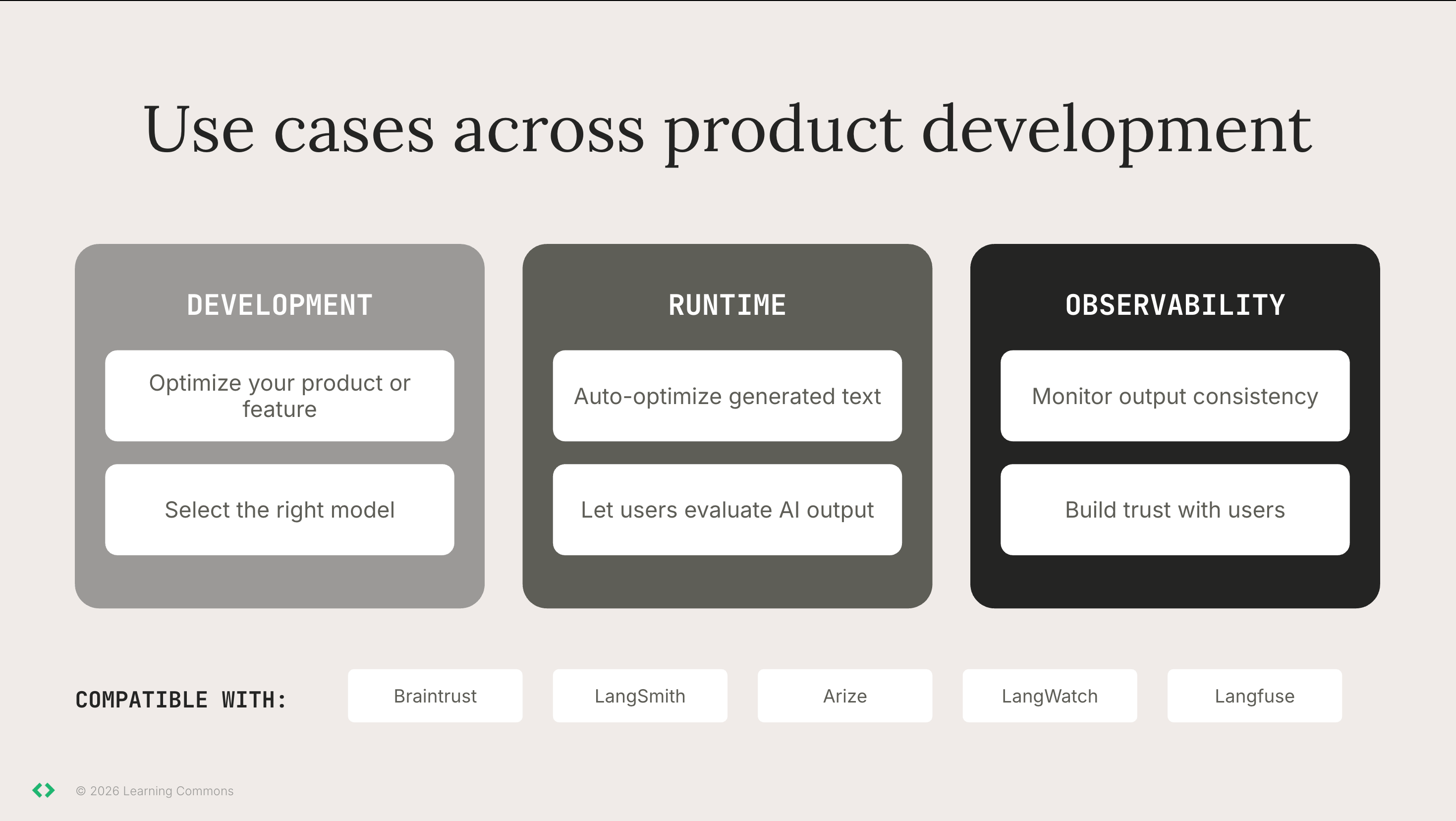
| Use case | Examples | Implementation |
|---|---|---|
| Optimize your product or feature | You are building a vocabulary-focused feature – you want higher vocabulary difficulty and simpler sentence structure. You are creating read-aloud support and want to deprioritize vocabulary complexity. | Set targets for vocabulary and sentence structure against grade level appropriateness. Run the Sentence Structure Evaluator and Vocabulary Complexity Evaluator on your LLM outputs to confirm that they stay in acceptable ranges. |
| Select the right model | You need to compare new models on quality, speed, and cost before switching. | Create a gold set with expected scores for key parameters (e.g., grade level, topic, text type). Use evaluators as a standardized benchmark to monitor drift from your baseline. |
| Check your output at runtime | Your AI outputs may not always meet all your criteria (i.e., grade level appropriateness for K-3). | You can auto-optimize your AI-generated output or let users evaluate the output themselves. |
| Monitor output consistency | Your AI output starts to vary unexpectedly after model drift or small system updates. | Run regular regression tests on your LLM outputs and compare scores over time to ensure stable behavior. |
| Build trust with users | Districts and educators ask for evidence that your AI-generated content is high-quality and aligned with learning principles. | Share your evaluation process and results so stakeholders can see the rigor behind your system and trust that your outputs remain consistent and research-aligned. |
Related topics
Quickstart
Run an evaluator in the Evaluators playground, a Python notebook, or with
the SDK.