Using Knowledge Graph
You can access Knowledge Graph data in several ways: Each access method has their own unique use cases and benefits.Steps
- Local files
- REST API
- MCP server
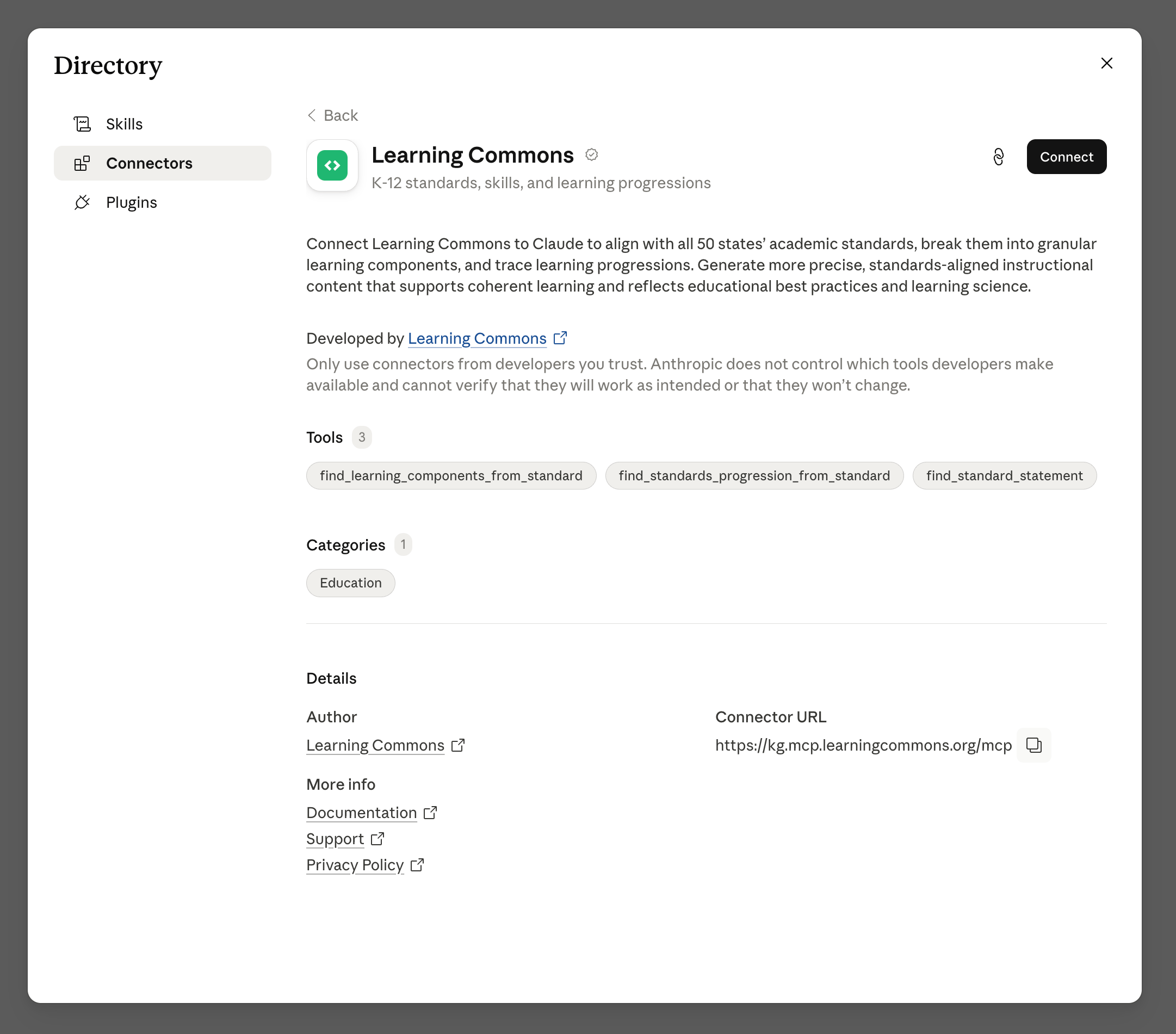
- Claude connector
Query the Knowledge Graph for the educational data you’re interested in.
Download the Knowledge Graph JSONL files
See download options.
Install jq
Install
jq ↗, a lightweight command-line JSON processor.Query the JSONL files
Query your downloaded files for the data you’re interested in.e.g., To get Common Core Math Standards, filter for nodes with a
StandardsFrameworkItem label, a Multi-State jurisdiction (Common Core), and a Mathematics academic subject:jq -c 'select((.labels | contains(["StandardsFrameworkItem"])) and .properties.jurisdiction == "Multi-State" and .properties.academicSubject == "Mathematics")' nodes.jsonl > common_core_math_standards.jsonl
Retrieve a list of Academic Standards for Multi-State Mathematics.
Generate your API key
Sign up for the Learning Commons Platform ↗ to generate an API key and get your base API URL.
Get a standards framework UUID
Send a request to the Copy the
GET /standards-frameworks API endpoint to get the caseIdentifierUUID for Multi-State Mathematics.curl -X GET \
-H "x-api-key: YOUR_API_KEY" \
"https://api.learningcommons.org/knowledge-graph/v0/standards-frameworks?academicSubject=Mathematics&jurisdiction=Multi-State"
import os
import requests
# Setup
api_key = os.getenv("API_KEY") # Your API key from Learning Commons Platform
base_url = os.getenv("BASE_URL") # Your base URL from Learning Commons Platform; follows https://api.learningcommons.org/knowledge-graph/v0 format
headers = { "x-api-key": api_key }
response = requests.get(
f"{base_url}/standards-frameworks",
headers=headers,
params={
"academicSubject": "Mathematics",
"jurisdiction": "Multi-State"
}
)
result = response.json()
print(result)
const apiKey = process.env.API_KEY; // Your API key from Learning Commons Platform
const baseUrl = process.env.BASE_URL; // Your base URL from Learning Commons Platform
const response = await fetch(
`${baseUrl}/standards-frameworks?academicSubject=Mathematics&jurisdiction=Multi-State`,
{
method: 'GET',
headers: { 'x-api-key': apiKey }
}
);
const data = await response.json();
console.log(data);
caseIdentifierUUID from the response to use in the next step.Retrieve Academic Standards
Use the
caseIdentifierUUID with the GET /academic-standards API endpoint to retrieve the individual standards for that framework.curl -X GET \
-H "x-api-key: YOUR_API_KEY" \
"https://api.learningcommons.org/knowledge-graph/v0/academic-standards?standardsFrameworkCaseIdentifierUUID=YOUR_UUID_FROM_STEP_1"
import os
import requests
# Setup
api_key = os.getenv("API_KEY") # Your API key from Learning Commons Platform
base_url = os.getenv("BASE_URL") # Your base URL from Learning Commons Platform
framework_uuid = "YOUR_UUID_FROM_STEP_1" # Copy from Step 1 response
# Make request
headers = {
"x-api-key": api_key
}
response = requests.get(
f"{base_url}/academic-standards",
headers=headers,
params={
"standardsFrameworkCaseIdentifierUUID": framework_uuid
}
)
result = response.json()
print(result)
const apiKey = process.env.API_KEY; // Your API key from Learning Commons Platform
const baseUrl = process.env.BASE_URL; // Your base URL from Learning Commons Platform
const frameworkUuid = "YOUR_UUID_FROM_STEP_1"; // From Step 1 response
const response = await fetch(
`${baseUrl}/academic-standards?standardsFrameworkCaseIdentifierUUID=${frameworkUuid}`,
{
method: 'GET',
headers: {
'x-api-key': apiKey
}
}
);
const data = await response.json();
console.log(data);
Response
{
"data": [
{
"identifier": "e1755456-c533-5a84-891e-59725c0479e0",
"caseIdentifierURI": "https://satchelcommons.com/ims/case/v1p0/CFItems/6b9bf846-d7cc-11e8-824f-0242ac160002",
"caseIdentifierUUID": "6b9bf846-d7cc-11e8-824f-0242ac160002",
"name": null,
"statementCode": "3.NF.A.1",
"description": "Understand a fraction $\\frac{1}{b}$ as the quantity formed by 1 part when a whole is partitioned into b equal parts; understand a fraction $\\frac{a}{b}$ as the quantity formed by a parts of size $\\frac{1}{b}$.",
"statementType": "Standard",
"normalizedStatementType": "Standard",
"jurisdiction": "Multi-State",
"academicSubject": "Mathematics",
"gradeLevel": ["3"],
"inLanguage": "en-US",
"dateCreated": null,
"dateModified": "2025-02-05",
"notes": null,
"author": "1EdTech",
"provider": "Learning Commons",
"license": "https://creativecommons.org/licenses/by/4.0/",
"attributionStatement": "Knowledge Graph is provided by Learning Commons under the CC BY-4.0 license. Learning Commons received state standards and written permission under CC BY-4.0 from 1EdTech."
}
],
"pagination": {
"limit": 1,
"nextCursor": "eyJpZGVudGlmaWVyIjogImUxNzU1NDU2LWM1MzMtNWE4NC04OTFlLTU5NzI1YzA0NzllMCJ9",
"hasMore": true
}
}
Ask about Academic Standards, Learning Components, or Learning Progressions.
Generate your API key
Sign up for the Learning Commons Platform ↗ to generate an API key.
Set up environment variables
.env
OPENAI_API_KEY=
MCP_AUTH_KEY=
MCP_SERVER_URL=https://kg.mcp.learningcommons.org/mcp
Connect to the MCP server
Make a request to the MCP server with your question – e.g., “What are the learning components for California standard 4.OA.A.3?”
import os
import requests
from dotenv import load_dotenv
load_dotenv()
response = requests.post(
"https://api.openai.com/v1/responses",
headers={
"Content-Type": "application/json",
"Authorization": f"Bearer {os.getenv('OPENAI_API_KEY')}",
},
json={
"model": "gpt-4o",
"tools": [
{
"type": "mcp",
"server_label": "learning-commons-kg",
"server_url": os.getenv("MCP_SERVER_URL"),
"require_approval": "never",
"headers": {"x-api-key": os.getenv("MCP_AUTH_KEY")},
}
],
"input": "What are the learning components for California standard 4.OA.A.3?",
},
)
print(response.json())
import "dotenv/config";
const response = await fetch("https://api.openai.com/v1/responses", {
method: "POST",
headers: {
"Content-Type": "application/json",
Authorization: `Bearer ${process.env.OPENAI_API_KEY}`,
},
body: JSON.stringify({
model: "gpt-4o",
tools: [
{
type: "mcp",
server_label: "learning-commons-kg",
server_url: process.env.MCP_SERVER_URL,
require_approval: "never",
headers: {"x-api-key": process.env.MCP_AUTH_KEY},
},
],
input: "What are the learning components for California standard 4.OA.A.3?",
}),
});
console.log(await response.json());
If using an SDK, verify how to pass in the MCP authorization key for your
client.
Review the response
Your AI client will call Knowledge Graph MCP tools to return structured results (e.g., standard statements, Learning Components, etc.).Inspect
mcp_call output entries for tool names, arguments, and results.Get authoritative Academic Standards data when asking about a standard code.
Get Claude
Sign up for a Claude ↗ account.
Enable the Claude connector
Set up the Knowledge Graph integration in Claude ↗ from the Claude connector directory.

Ask about a standard
Mention the grade level, state, and/or standard code (e.g.,
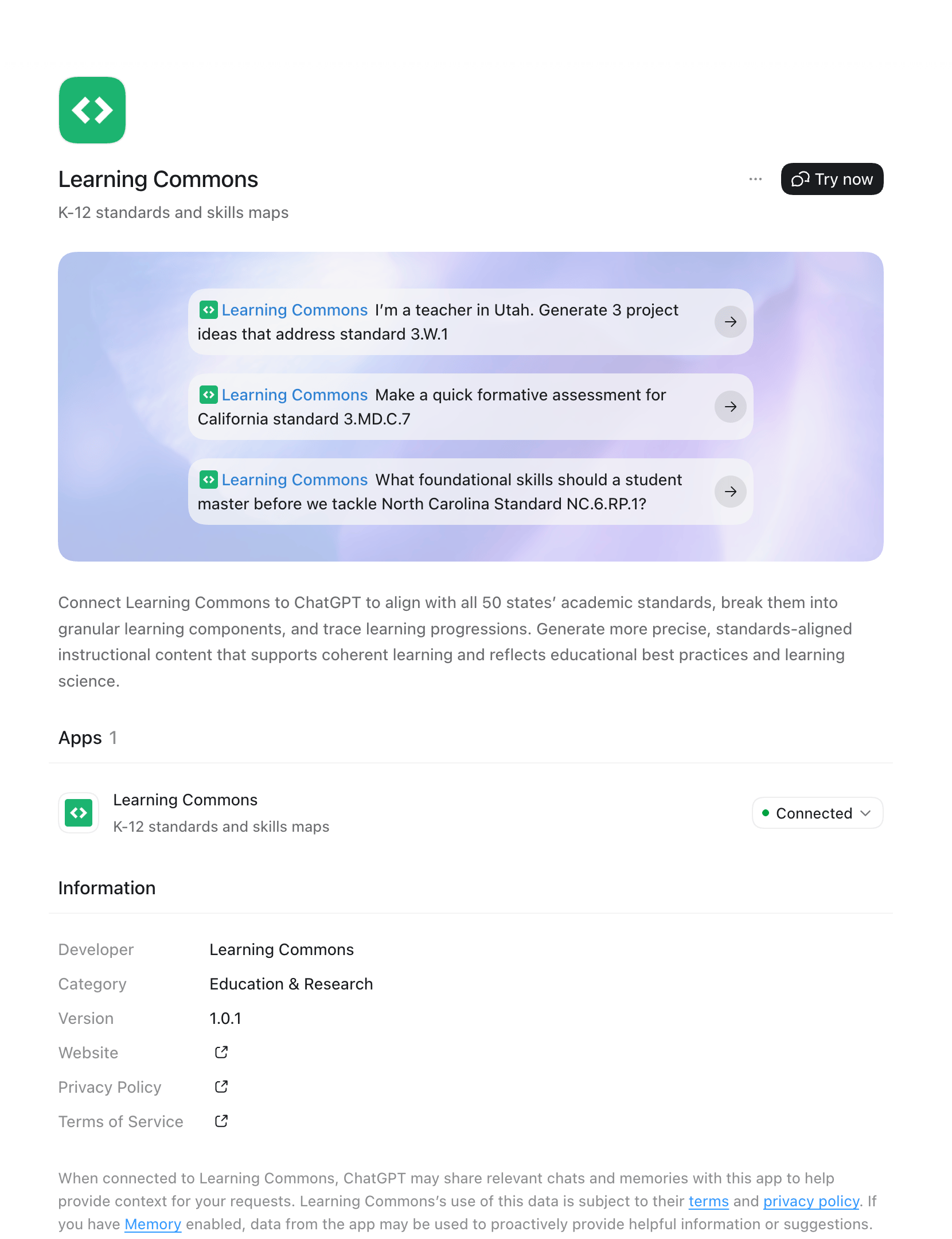
5.NBT.A.2 or RL.4.1) that you are interested in:- “I’m a teacher in Iowa. Generate three project ideas that address W.3.4.”
- “I am a 4th-grade teacher in California. A student is struggling with 4.OA.A.3. Which prior standards should I focus on?”
Next steps
API Reference
Explore other API endpoints to access Knowledge Graph data.
Claude connector
See more example prompts and how the connector works behind the scenes.
Entity and relationship reference
Understand the data models that make up the Knowledge Graph.
MCP server
See server URL, authentication, available tools, and full examples.
Tutorials
Follow step-by-step guides to build with the Knowledge Graph.